Character stats
Most of the characters that the players will encounter during their adventure will only live inside the (deranged) mind of the GM, but the most important ones will be described in greater detail through a bunch of numbers, terms and idioms. Those are usually set down on paper on something we call a character sheet.
This includes the player characters themselves as well as the main villains, quest helpers, notable persons and some poor souls that the players will never encounter because they decided to go gods know the fuck where instead of following the carefully crafted scenario.
Attempting to portray a complex living being so rigidly may seem foolish at first, but give it enough time and I swear you will manage to convince yourself it makes sense.
Skill Checks
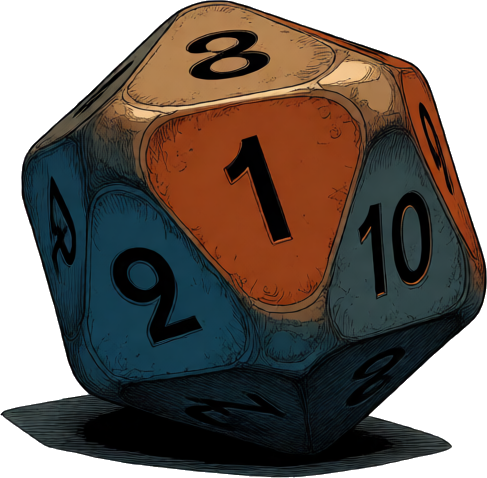 When a character attempts an action during the course of the game, the GM may choose to make them roll dice to determine
how bad they fail the outcome. And this, you see, is where the aforementioned stats suddenly become fruitful and not just the result of excel monomaniacal delusion.
There are two different kinds of tests: Skill check and Opposed check, the former is done against an abstract difficulty chosen by the GM, the latter against an opponent also rolling dice. In both cases the character needs to roll a number of 10 sided dice (d10) equal to the sum of a chosen attribute plus skill, and have at least a number of those dice getting above a given value, called the threshold, which will be six most of the time. Each die rolling equal to or above this threshold is called a hit. The number of hits required depends on the chosen difficulty in case of Skill check or the number of the opponent's hits in case of an Opposed check.
The dice with a value of 1 each drop the number of hits by 1.
For an Opposed check, in case of equality, the attacker wins, if there is no attacker (for example during arm wrestling) then the action will usually end in a draw. In the rare cases where this is not possible the GM will choose the winner in all fairness.
Skill check difficulty table (it's not supposed to be a hard truth, smooth flow is more important than accuracy):
| difficulty | |
|---|---|
| 1 | Easy peasy |
| 2 | Fine, no sweat |
| 3 | Challenging |
| 4 | Fucking hard |
| 5 | Pro territory |
| 6 | Wild |
| 7 | Borderline impossible (to regular non power fantasy people) |
| 8 | Are you OK GM? Maybe take your pills |
 |
|
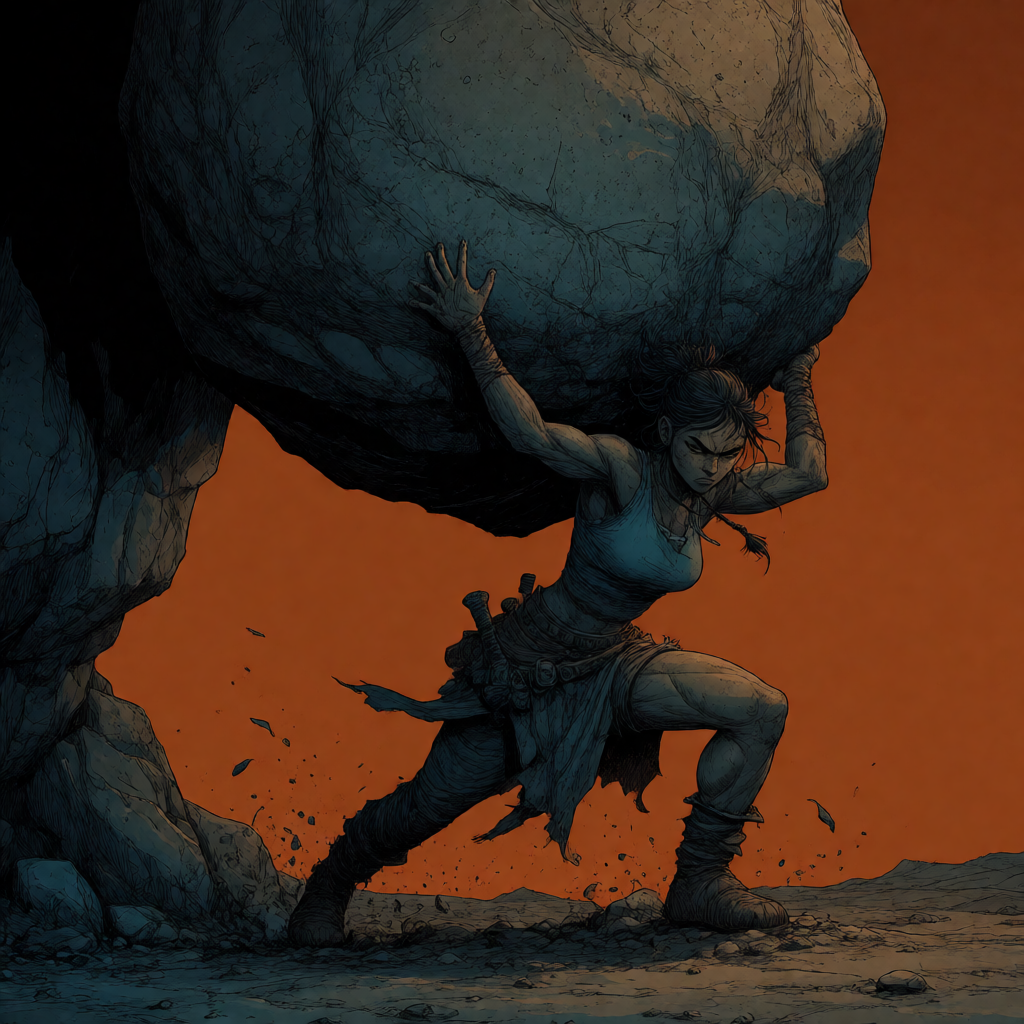
| > Skill check example: Xena needs to move around a heavy boulder in order to free the passage to an evil cultists' lair, this is not an easy task and as such the GM decides to make her do a skill check in order to assess her success. Asking her for a Strength (attribute) + Athletics (skill) check and announcing peremptorily that the difficulty is 3. Xena has 4 in Strength and 1 in Athletics, she rolls 5 10-sided dice (5d10) and counts the dice having a value of 6 or greater. She rolled respectively 1, 3, 6, 7 and 10; that is 3 dice with a value equal to or greater than 6, that would be the three requested hits, unfortunately she also rolled a 1 which lowers the result to two hits and consequently the boulder, after having shifted slightly, remains in place. Xena is not happy and starts a tirade on how her muscles are tired for doing everything herself in this group - despite specifically asking to do it alone to show off. |
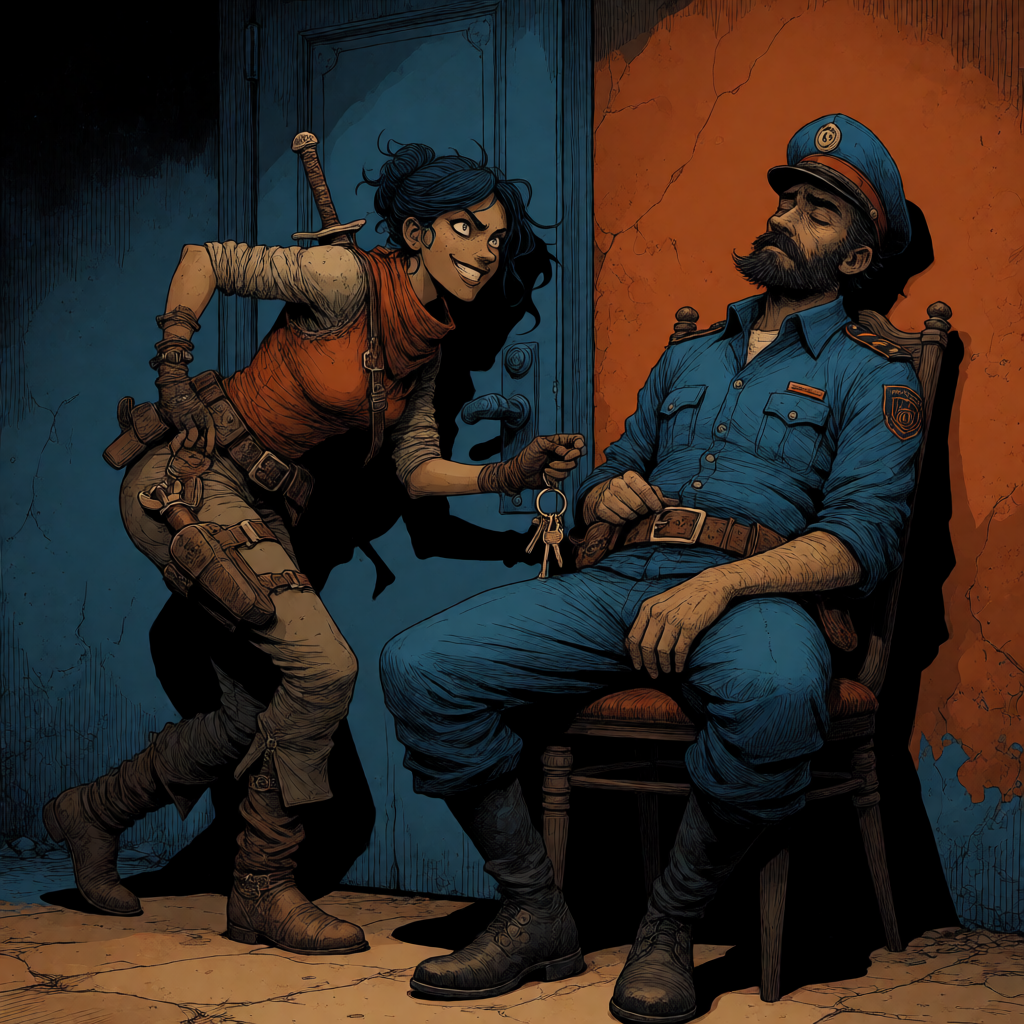
Opposed check example: After deciding to use the other entrance to the evil cultists' lair, a perfectly functional looking door, Xena decides to attempt to steal the keys from the sleepy guard. With a malicious grin, the GM tells her that she needs to roll Agility (attribute) + Stealth (skill) and beat the guard's Awareness (attribute) + Security (skill) own roll. Xena rolls two dice (2 agility + 0 stealth) and gets a 2 and a 6, that is one hit; the guard rolls five dice, 1 4 4 8 10, which makes a bit unlucky one hit as well. Since Xena is the attacker in this case she wins the opposition. After tiptoeing to the guard and very slowly removing the key from his belt, she turns and starts going back to her group.
Threshold, advantage, disadvantage and other modifiers
Most regular skill checks will use 6 as the threshold to beat, namely, the minimum target value to achieve for each die to be considered a hit. Some effects may change this threshold for a single die (exp. applying status effects on attacks), on all the dice in a single roll (exp. casting magic) or across the board (exp. character is exhausted).
A number of modifiers may change the outcome of dice rolls, the most common ones being advantage and disadvantage. They respectively allow rerolling the lowest die and force rerolling the highest die. A typical usage of this would be when two characters are doing an action that requires a check together, rather than both rolling dice only one of them will be doing the test but with advantage. Or when trying to do an action in an unfavorable setting, in the dark or in the rain for instance.
Shift allows modifying the value of a die in one direction by up to a given number, for example +shift 2 means the character may change a 4 into a 5 or 6; -shift 1 means the character may change a 6 into a 5. +shift is usually applied to the character's own dice while -shift to an enemy's dice.
Degrees of success
In some cases it might be relevant to figure out not only if an action is a success or a failure, but by how much. Each hit above the target difficulty adds to the degree of success, eventually leading to more or less beneficial consequences.
When rolling at least two 10s and no 1s, the check is considered a critical success, it is a success regardless of the difficulty and something crazy and theatrical should happen.
When rolling no hits and at least a 1, the check is considered a critical failure, and something incredibly bad for the unfortunate character rolling the dice should happen.
Attribute check
Sometimes no skill seems to correspond to a check, in which case the test might only use a naked attribute rather than an attribute plus skill combo. Note that, in this case, the difficulty should be lowered significantly since way less dice (about half) will be rolled. Yes, in a sense this is sort of a third kind of check but it works exactly the same and I didn't want to confuse you at first, don't be difficult OK?
Attribute check difficulty table:
| Difficulty | |
|---|---|
| 1 | Too ez |
| 2 | Bearable |
| 3 | Rough |
| 4 | Ludicrous |
Xena is still entranced by her undeniable victory over the hearing capacity of the guard and after a couple steps, not able to contain her pride anymore, shouts off a resounding 'TA-DA'. Not stopping to wonder whether her demonstration might wake the guard up. The GM asks her to make a Wits (attribute) check to grasp this, not telling her the difficulty in advance, arguably for theatrics - but really mostly because they don't have a clue at the time. Xena rolls a 1 with her one in Wits, critically failing to realize what she had done. The guard, woken up with a start, jumps to his feet and after a short moment of surprise runs away to raise the alarm before anybody can react.
Bargaining another skill
Since the skills list is not supposed to be exhaustive and the player characters may have some exotic competences that they think could be relevant when confronted with a check, they may propose to the GM to use another skill instead. In their infinite leniency the GM may accept if they think it makes sense, maybe changing the difficulty according to the new set.
The sound of the guard's footsteps fleeing the scene is enough to make Xena turn around, ending her triumphant display. She decides to once again take matters into her own hands and attempt to catch him before the other cultists get wind of the adventurers' presence. The issue is that two corridors depart from the entrance, and Xena doesn't know which one the guard took. The GM, a bit annoyed at this point to ask for so many skill checks in a row, laconically announces - give me logic plus investigation to figure out which one he went in, please, difficulty 2.
But Petunia, who plays Xena, knows that neither Logic nor Investigation are Xena's strong suit, she then proposes Awareness plus Tracking instead, stating that she can follow the freshest set of tracks in the dirt. After careful consideration, because they are an evil bastard, the GM decides that the lair is in fact paved in stone and following tracks in the dust of an overused passageway is very difficult. He accepts but the difficulty rises to 4. Xena unsurprisingly fails miserably.
Using Rerolls
A Reroll is a resource that the GM will sparingly award to players for their good actions, impressive roleplay, humour or bribe. Spending one Reroll allows a player to roll again any set of dice in its entirety if they deem it was important enough and are not happy with the result.
Now that we covered the basics, go ahead and read about Creating a character.