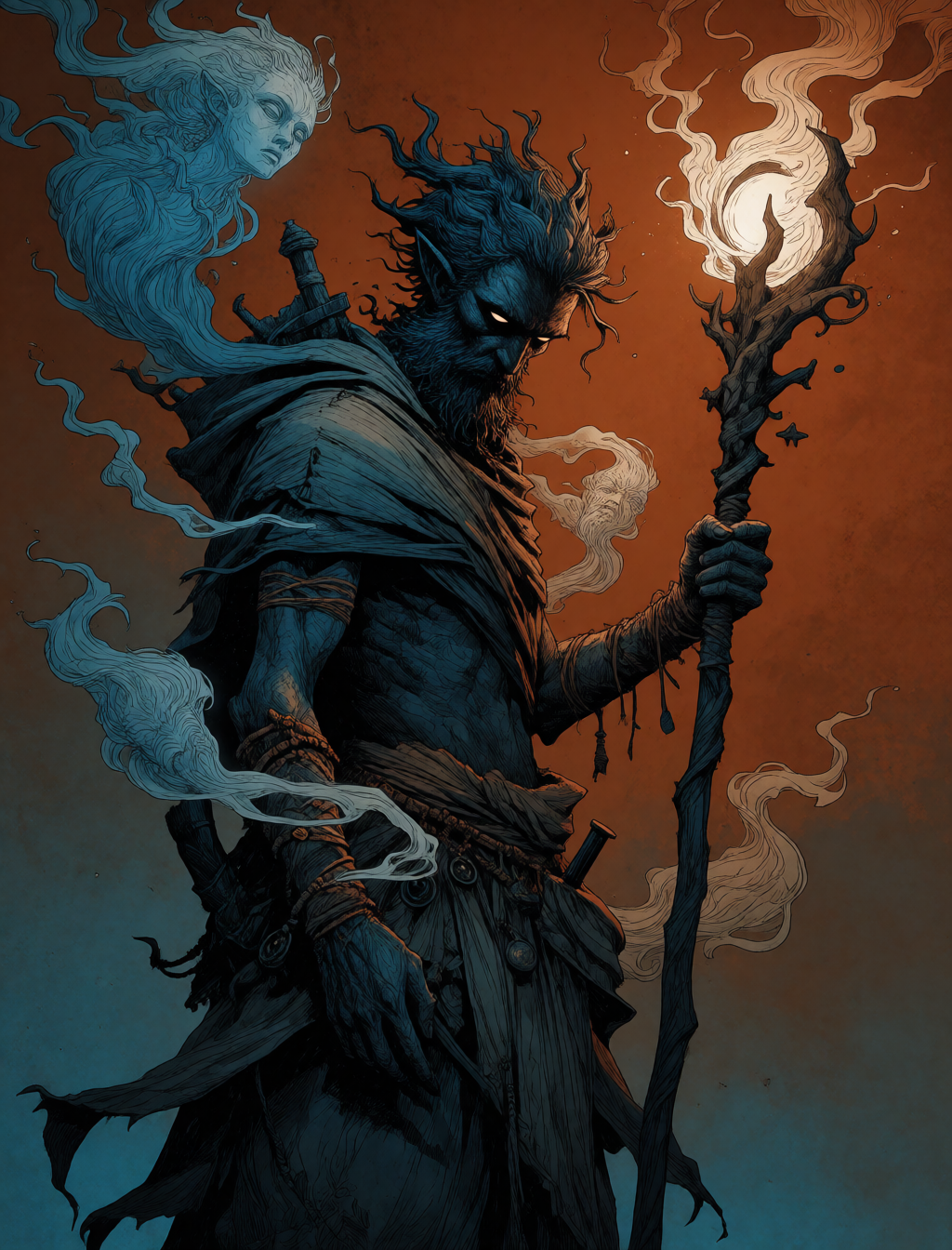
Stats
| Max Mana | max(Empathy, Duplicity) |
| Skills | Psychology, Herbalism, Leadership |
| Governing attributes | Empathy, Duplicity, Willpower, Resilience |
| Class Attack | cf bound spirits |
| Class Spell | cf bound spirits |
A shaman is someone with a particular link to the ether — they feel magic the way others feel heat, or a change in the weather coming. For most, that sensitivity speaks loudest as the dead: shamans see and bargain with spirits, the lingering ghosts the ether would not let go, and channel a bound soul's magic through their own body. But the spirits are only the loud part of it. Where another caster studies, prays, or is simply born to their power, a shaman borrows and listens — quiet and perceptive alone, and, with the right spirits at their side, able to call down lightning, mend a wound, or terrify a room. Every one of those gifts belonged to someone once, and comes with a story and a price.
Having a shaman at the table gives your GM a lot of extra work (designing and roleplaying spirits), check with them if it's ok and fits the rythm of the scenario/campaign.
Ether-Touched
Long before a shaman ever meets a ghost, they feel the ether move. Magic has a texture to them, and they read its shifts the way a sailor reads the sky: the skin-crawling wrongness of a deeply corrupted place; the held breath and rising dread in the hours before a Fracture; the faint, insistent pull of a relic or a working of real power, felt clear across a room or a valley. It is an unreliable gift — more mood than message, easy to misread and impossible to switch off — but a shaman who learns to trust it is rarely caught flat-footed by the unseen. Speaking with the dead is only the most dramatic thing this sensitivity does; sensing the shape of magic is the everyday of it.
What the Ether Keeps
Spirits are the dead who did not move on. When a person dies, something of them can stay snagged in the ether instead of passing — held by unfinished business, fixed by a ritual or a curse, anchored by an emotion too strong to release, or simply possessed of a mana affinity so fierce the soul refuses to come apart. What remains is conscious, but seldom whole: a spirit may be lucid, or fading, or warped by however it died and however long it has clung on. Most carry their old nature with them — and the magic that nature implies.
Almost every spirit has a way out — a prescription, some condition that would finally let it rest: a wrong avenged, a body buried, a promise kept, a perfect cup of tea poured. A shaman is one of the few who can see them, speak with them, and bargain. A kind shaman earns a spirit's trust, borrows its power for a while, and in time helps it on its way; a warlock simply binds it in chains and wrings it dry. Either way, to carry a spirit is to carry a dead stranger's grudge or grief around in your own chest — which is exactly as heavy as it sounds, and part of why the gift is rarer than it looks.
Class bonus
A shaman starts with one perk:
Spiritual (starting perk): You can see and speak with spirits and with enough trust form bonds. A bound spirit works like a small, personal magic school: it grants you a short list of thematic spells drawn from its nature and its story, which you cast by channelling the spirit through your body. Its spells open up as your bond deepens; a new spirit lends you little, a trusted one its whole repertoire. You begin able to hold one bind at a time.
Channelling a spirit costs it ether fatigue: lean on it too hard and it falls silent until it rests, and a spirit worked past breaking — or forced — can have its very mind frayed. Each spirit regain one ether fatigue per session.
Each spirit is held by some unfinished thing and carries a prescription: a condition that would free it. Fulfil it and the spirit moves on: you lose its school, but the parting leaves you something lasting, most often one of its spells kept for good (your GM has the final say, a perk or a keepsake may fit a given spirit better).
As they level up, shaman perks widen the bond: holding more spirits at once, sending a spirit tangible to strike, walking the ether untouchable, borrowing a spirit's own knack for a task, and easing their fatigue so they last.
Class malus
Malevolent spirits may appear, unbidden, to torment a shaman; and a spirit you have broken or betrayed is the likeliest of all to come knocking.
Paths
Warlock: stop asking. Shackle spirits and wring their power out by force, you bind faster and harder, leaning on Duplicity in place of Empathy, but you make enemies of the dead and your spirits never last.
Parasitic: take a single powerful spirit into you as a permanent host. It sharpens your attributes and lends its strength. But it keeps its own will, and now and then it may take the wheel.
Dreamer: your dreams stop staying dreams. Walk them, shape them, and slip into the dreams of others.
Example spirits
A spirit is quick to build: an element, three or four thematic spells, a prescription, a standout knack, and a temperament.
Thunder Crow — Air, vengeance. A man betrayed to his death and unwilling to forgive it. Spells: a lightning strike; a betrayer's curse that turns a target's luck and allies against them; a deafening thunderclap; crow's-eye scouting. Prescription: see the traitor exposed or avenged. Knack: implacable will. Temperament: cold, fixated.
Fiery Fox — Fire, hearth and fear. A child left alone to die. Spells: a comforting warmth that mends and steadies; a frightened flare; a clinging "don't leave me" that snares those who try to flee it; a darting fox-shape to scout. Prescription: to be kept safe and never abandoned again, or finally laid to rest. Knack: raw, overwhelming feeling. Temperament: frightened, devoted, apt to lash out.
The Angry Teapot — Fire and steam. An ancient ritualist who flubbed a great working and wound up bound in his own kettle. Spells: a scalding jet of steam; a shrieking whistle that rattles the nerves; a wild surge of half-finished ritual magic that does something; a pompous scrap of genuine lore. Prescription: complete the ritual he botched — or simply pour him one perfect cup and call him the genius he was. Knack: real ancient erudition. Temperament: furious, vain, insufferably pedantic.